Month: January 2015

What’s in the name?

“A rose by any other name would smell as sweet” said the bard in Romeo and Juliet So what’s in a name?

Some dogs are famous individuals – Lassie, Rin Tin Tin, Inspector Rex, and Hairy Maclary from Donaldson’s dairy. Their names are famous because of their pursuits, or what they achieve.

But some dogs are famous as groups. The St. Bernards with the keg of brandy around their necks, St_Bernard_with_barrel_alt

the explosives detection dogs which support our diggers,201492-sapper-darren-smith

the sniffer dogs looking for drugs or illegal imports. Quarantine detector dog

And of course, guide dogsSoutheastern+Guide+Dogs+Puppy

I love my guide dog. She is great at her job. I love walking, and she provides me with a far more relaxed and faster means of travel. On familiar routes she is almost perfect.

arrow is the cutest

She’s also a great addition to the family. She provides support and safety to my teenage daughter. She is an excellent foot-warmer for my wife. Her friendly lick on my leg in the morning is a great start to my day. And her leaps of excitement when I get out her harness so she can work just give me a warm inner glow.

But why is her name so important? “What’s your dog’s name?” is the most common question I am ever asked.

My standard answer is – “I don’t use her name unless I’m giving her a command”. I answer this way both because it is true (she responds very well to her name and I don’t want to lose that), and because if I tell people her name it will encourage them to pat her, or interact with her when she is working. These things make it harder for her to work, and puts my safety at risk.

During the time we have worked together (about eight years) I have been asked this question about six thousand one hundred and forty five times. That’s more times than most test cricketers score runs in their careers.  It’s not quite as many times as my dog and I have had hot dinners,dutch-hotmeals-mainbanner but its close to podium. Aus PC X Bradbury

I understand that people are evincing a genuine interest, and I get why they want to know. But I am well and truly over answering this question. I find it a little unnecessary and intrusive, but much less so than a lot of other questions people with disabilities are asked. But you can only repeat the same answer so many times before you start seriously contemplating the more extreme alternatives – which could involve physical harm to the questioner or the answerer.

I don’t want to be rude when I answer, saying things like “mind your own business” or “I’m not telling you.” That’s not the best way to oil the wheels of human interaction.
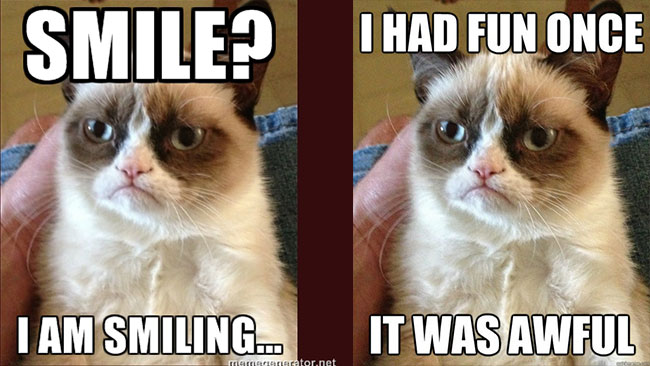
284578-grumpy-cat.gif

I don’t want to keep saying what I have said for years – not because its not true, but because I’m downright bored with saying it.

bored_lion

Perhaps I should try flippancy – “I can’t tell you, she’s working under cover” Screen Shot 2015-01-25 at 9.40.34 am or “I’ve forgotten”.

Perhaps I should attach a small speaker to her harness, so that I can play a message saying “I’m sorry Dave, I can’t tell you that.”

chess_2001_space_odyssey

What do you think? Please give me some ideas? I’m getting desperate! All suggestions will be seriously considered, and I will tweet the ones I choose.

(Graeme Innes has come to the end of his repetitive tether, and is desperate not to be dogged by the same request).

Throwing your lollies out of the Cot

Changing attitudes changes lives Cody’s story will cause different reactions.

Many people will be appalled that teenagers could be allowed to play a game like rugby where such serious spinal injuries could occur. Many people will be saddened about a young life they consider much diminished, and view Cody as a victim. Many people will think that Cody and his family were heroes because of the positive approach they took in the face of such adversity. Only a few of us will think, as I do, “I’m sorry that occurred.

Disabilities requiring someone to use a wheelchair, just like other disabilities, are part of the human condition. How can we best support Cody to enjoy and contribute for the rest of his life.” Cody shares my views. He says “I don’t want people to treat me any different. I’m sitting down all the time, but apart from that I’m still the same.”

And his story, and the interaction with his family and mates, bear this out. Negative attitudes towards people with disabilities do not come – in the main – from hatred, meanness or negative intentions. They come from lack of awareness and understanding. Cody was sixteen when his accident occurred. His story, the first episode in the Attitude series on ABC television at 6 30 on Saturday nights, (and available on ABC iView) is one of many being experienced by people with disabilities.

We are teenagers, sports players, mums, bankers, accountants, truck-drivers, teachers, lawyers, doctors, academics, etc etc etc. We just want to live our lives, not as victims or as heroes, but as agents of our own destiny. And the biggest barrier we face in doing that is the Attitude barrier – we are prevented from living our lives by the limiting and negative assumptions made about us by people without disabilities. Every day, on the train, in the street, in my work and in my leisure people assume that there are things that I cannot do because I cannot see.

There are a few – but trust me not nearly as many as you think. I read, I write, I travel, I love, I parent, I pay the mortgage – ordinary things that ordinary Australians do, whether or not we have disabilities. Cody’s story, and the six other episodes in the Attitude series currently going to air, are taken from “the vault” of Attitude Pictures in New Zealand.

They have been making such programmes as these in New Zealand for the past ten years to change attitudes of people in New Zealand towards people with disabilities. And they are succeeding! We want to do the same thing in Australia – change the attitudes of Australians towards Australians with disabilities. Because we know that changing attitudes changes lives.

If an employer accepts that I can work as a lawyer, rather than assuming that I can’t, and gives me a job, that will change my life. If a fashion retailer assumes that people with disabilities buy fashionable clothes, and includes models with disabilities in its advertising, that will change our lives.

If you use pictures as well as words in your signs, that will change our lives. If you don’t park in our accessible parking spaces, that will change our lives. And if you caption your advertisements on tv and in cinemas, so that people who are deaf or hearing impaired can follow the spoken word, that will change our lives.

Cody’s story is powerful because of his attitude. He says “I love challenges. i’m happy to come across something I can’t do, and go back to it later in the week or in a few years, until I can do it.” And Cody’s dad says “He hasn’t thrown his lollies out of the cot. He’s got plans. He’s gonna be a Wheelchair Black.”

You can help Change Attitudes by supporting our Start Some Good campaign. We are crowd-funding our first Australian programme, and we’ll build to an Australian series. Join us today to help change attitudes towards people with disabilities.